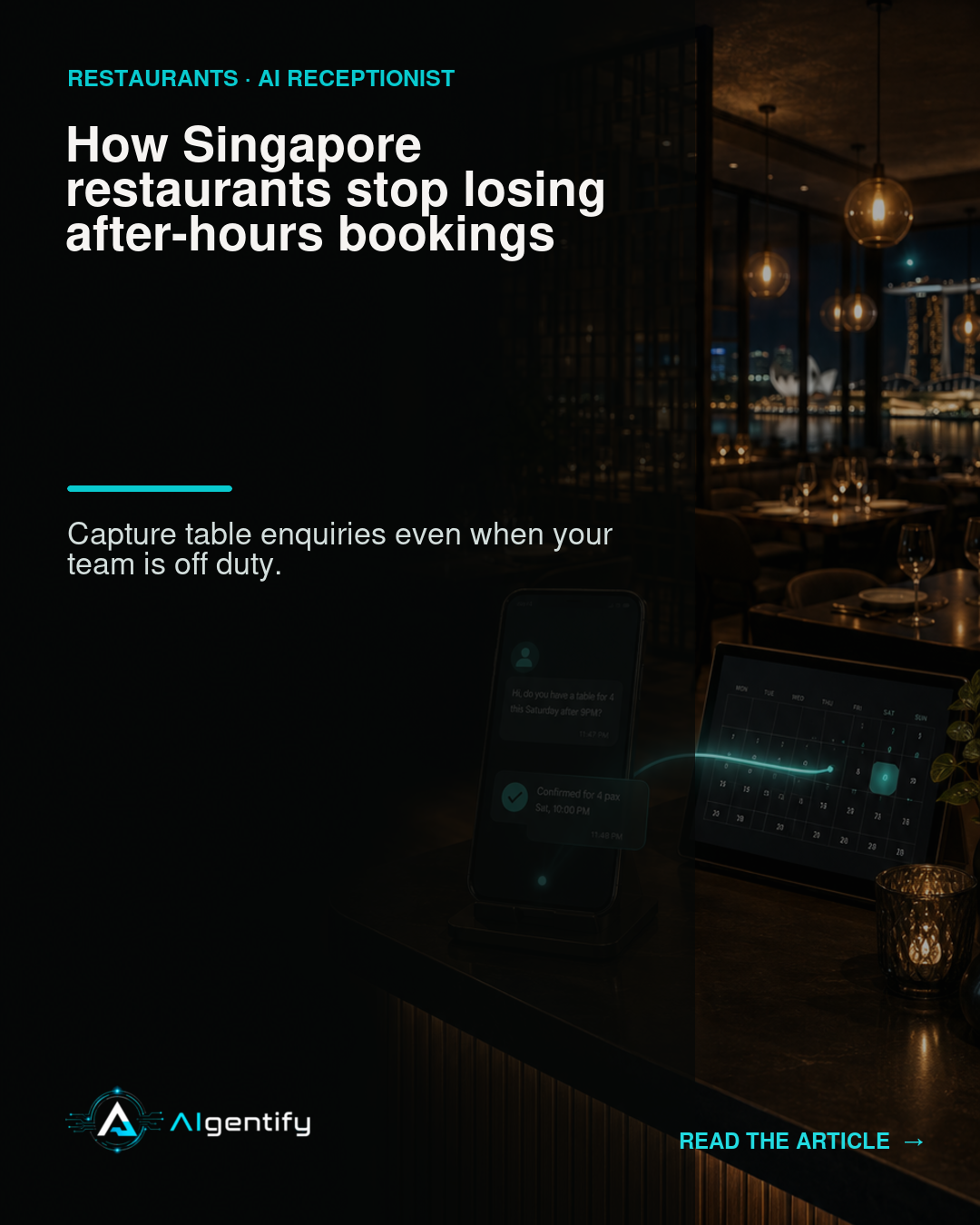
The enquiries you never see
Ask any Singapore restaurant operator when their phone rings and they will describe service hours. Ask their booking data the same question and a different picture appears. A meaningful share of enquiries — messages, missed calls, form submissions, Instagram DMs — arrive after the kitchen closes, on the one day a week you are shut, or in the ninety minutes before opening while the team is prepping.
Those enquiries do not wait politely. A guest planning Saturday dinner on a Tuesday night messages three restaurants at once. Whoever replies first usually gets the booking. If your reply arrives at 11am the next morning, you are not competing on food or service. You have already lost on response time.
This is the quiet leak in most F&B businesses. It does not appear on a P&L as a line item. It shows up as covers you assumed were never available.
Put a number on it before you fix it
Before considering any solution, measure the gap. It takes one week and a notebook.
Count every inbound enquiry that arrives outside service hours: WhatsApp, phone, website form, social DM, email.
Note how long each one waited for a first reply.
Note how many converted to a confirmed booking.
Then run the arithmetic. Missed or slow-answered enquiries per week × your normal enquiry-to-booking conversion rate × average spend per booking = weekly revenue at risk.
A restaurant seeing fifteen after-hours enquiries a week, converting at 40%, with an average table value of SGD 140, is looking at roughly SGD 840 a week — around SGD 3,600 a month — sitting in an unanswered inbox. Your numbers will differ. The point is that you now have a real figure instead of a feeling, and any fix has to beat it.
Every unanswered enquiry is a booking that went to whoever replied first.
What an AI receptionist actually does
An AI receptionist is not a chatbot bolted to your homepage that answers "What are your opening hours?" and nothing else. In an operational sense, it is a digital front desk that works the channels your guests already use — WhatsApp, web chat, and phone — and completes a defined set of jobs end to end.
For a restaurant, that set is small and specific:
Answer the routine questions. Opening hours, location and parking, corkage, halal or vegetarian options, private-room minimums, whether the terrace is covered when it rains.
Take the booking. Check live availability against your reservation system, hold the table, capture party size, time, name and contact, and confirm in writing.
Manage the edges. Offer the waitlist when the slot is full, propose the nearest alternative time, take deposit details for large parties where you require them.
Reduce no-shows. Send the confirmation immediately and a reminder the day before, with a one-tap way to cancel or amend.
Escalate properly. A complaint, an allergy question with real consequences, a media enquiry, a fifty-person buyout — these go to a human, with the conversation history attached.
That last point matters more than the first four. The value of a good system is not that it handles everything. It is that it handles the eighty per cent that is routine, and routes the twenty per cent that is not to the person who should see it.
A realistic Tuesday night
A guest messages at 22:40, well after last orders: "Do you have a table for six this Saturday, around 7?"
The system replies within seconds, checks availability, and finds 19:15 open. It offers that, plus 20:00 as an alternative. The guest takes 19:15. It captures the name and mobile number, notes "one guest is vegetarian" from the follow-up message, and writes the booking straight into the reservation system. A confirmation goes out immediately; a reminder goes out on Friday evening with a cancel-or-amend link.
On Saturday morning your host opens the book and the table is there, with the dietary note attached. Nobody on your team touched it. The alternative — the actual alternative in most restaurants today — is that the message sits unread until 11am, by which point the guest has booked elsewhere.
Where humans stay in charge
Automation in hospitality goes wrong when it starts making judgment calls it should not. Set the boundaries deliberately, and write them down:
The system never invents availability. It reads your reservation system and respects your table plan, buffers and pacing.
Complaints, allergy conversations and anything involving a refund go to a person immediately.
Large-party and buyout enquiries are qualified, then handed to the manager with the details captured.
The tone is yours. The system uses your words for your policies, not generic hospitality filler.
Every conversation is logged and reviewable, so you can audit what was said in your name.
Guests do not object to being helped quickly by software. They object to being trapped in it. A visible, fast route to a human is not a fallback — it is part of the design.
Getting it live without disrupting service
The implementations that work start narrow.
Pick one channel. For most Singapore restaurants that is WhatsApp, because it is where guests already message you.
Write down the twenty questions you actually get. Your team can list them in fifteen minutes. That is your knowledge base, and it is more accurate than anything generated from scratch.
Connect the booking system. Read availability, write reservations. If it cannot write, you have built an answering machine, not a receptionist.
Run it after hours only, for two weeks. The risk is capped: during service, humans still handle everything. You are testing exactly the window where you currently lose enquiries.
Measure against your baseline. First-response time, after-hours enquiries answered, bookings created outside service hours, no-show rate. Compare with the week you counted at the start.
Extend only if the numbers move. If they do, widen the hours. If they do not, you have spent a fortnight and learned something specific.
What to watch out for
Three failure modes account for most disappointing projects.
Availability that is not real. If the system cannot see your live table plan, it will promise slots you do not have. Integration is not a nice-to-have; it is the whole thing.
A knowledge base nobody owns. Menus change, hours change, policies change. Someone on your team must own updates, and it should take minutes, not a support ticket.
No agreed measure of success. Decide before you start what result would justify continuing. Write the number down. It stops the project drifting into a permanent pilot.
The honest summary
An AI receptionist will not fix a restaurant with a food problem or a service problem. What it fixes is narrower and very common: enquiries arriving when nobody is there to answer them, and the bookings that quietly go elsewhere as a result.
Measure the gap for one week. If the number is small, spend your attention somewhere else. If it looks like several thousand dollars a month, it is worth two weeks of a controlled trial on one channel, after hours, with agreed metrics.
That is the entire recommendation. Start where it hurts, cap the risk, and let the numbers decide.
Start with a free AI Readiness Assessment
Normally valued at SGD 1,500, currently free. You receive an opportunity report, a prioritised roadmap and honest ROI estimates for your own processes — with no obligation. Book yours at aigentify.tech/assessment.
AIgentify — Singapore-based AI implementation specialists. We design, build and support AI agents, workflow automations and intelligent business applications with measurable ROI. Live in weeks, not months. Your data stays yours.
This article is general information, not advice. Grant schemes, platform rules and regulatory requirements change; confirm current details with the relevant authority or provider before relying on them. Any figures shown are illustrative unless a source is stated.